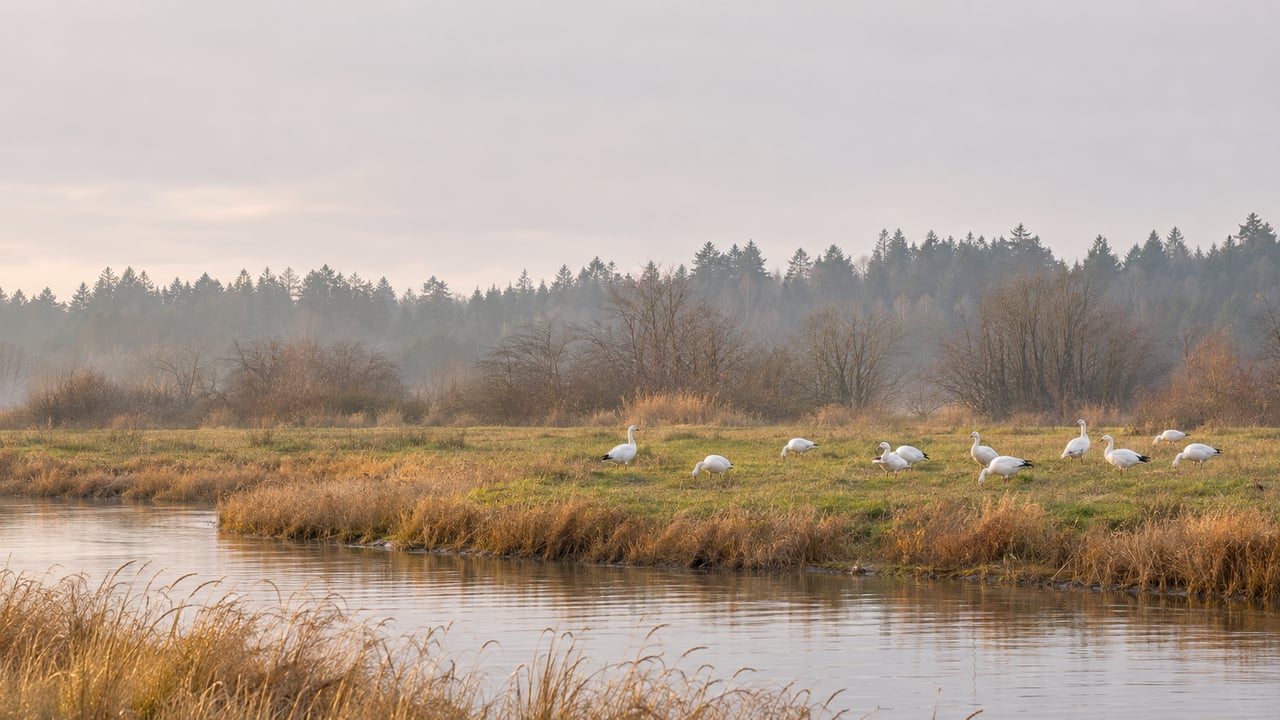
The snow geese are back in the fields around Stanwood. The Stanwood Area Historical Society's festival page says geese and swans were already being seen and heard in local fields and waterways in October. The state expects a big winter. The Washington Department of Fish and Wildlife's 2026 District 13 hunting prospects report predicts strong snow goose numbers coming into Washington. It adds that the flocks are spreading beyond their usual concentrations near Stanwood, with at least 5,000 to 10,000 birds expected to spend time in the Snohomish River system.
The public ground for watching them has changed this year. Leque Island, the closest open viewing area to downtown, was dug up again this summer. The nature preserve across the water stays closed until mid-February. And all season, a hunting calendar decides who else is out in the marsh with you. This winter, planning a goose walk means planning around those three things.
Leque Island Is a Different Walk This Year
WDFW finished another estuary restoration project on the Leque Island Unit in summer 2026. Crews dug new channels beyond the dike-top walking trail, built mounds and berms, and moved heavy equipment across the site. The department's September 15, 2026 alert says the work left new channels, steep banks, low areas, soft soil and other hazards that weren't there before. It asks waterfowl hunters and wildlife watchers to use extreme caution, especially at high water, when those spots can be hidden.
The island has been changing for years. In 2019, WDFW removed the dikes around Leque Island south of Highway 532, returning 279 acres to tidal marsh and digging more than five miles of new tidal channels. In 2022 it removed another 0.6 miles of dike north of the highway, opening 26 acres of salt marsh to full tidal exchange. The goal is habitat for juvenile Chinook salmon, which need estuaries as they move from fresh water to salt water. The side effect for walkers is that a route that felt familiar last winter may now end at a new channel or a stretch of soft ground.
The ways in haven't changed. The Leque Island Wildlife Area Unit page lists two small parking areas, one at the end of Eide Road and one in the northwest corner of the property at Davis Slough. You need a Discover Pass unless your vehicle carries a Vehicle Access Pass issued with an eligible hunting or fishing license. The same page carries a rule that matters right now. The unit is closed during hours of darkness except during legal hunting seasons. In practice, that means from fall into winter you may be sharing the parking lot with hunters before sunrise.
The Preserve Across the Water Is Closed Until February 15
Many people think of Port Susan Bay first when they think of Stanwood's geese. The Nature Conservancy describes the bay as some of the finest estuarine habitat in Puget Sound. Wrangel Island snow geese gather there by the thousands in the tidal marshes and nearby farm fields, along with hundreds of raptors, from peregrine falcons to short-eared owls. The Stillaguamish River feeds the bay and the marshes that make it a key stop on the Pacific Flyway.
But The Nature Conservancy closes its Port Susan Bay Preserve every year during hunting season, October 15 to February 15, for visitor safety. During that window it allows only group-led tours, by reservation. Visits need at least a week's notice through the conservancy's Seattle office, and every visitor must submit a liability form. That closure covers nearly the whole goose season, so for most people the preserve is something you see from across the bay this winter. The places you can just park and walk are the two WDFW sites.
A Calendar Built for Hunters, Read by Watchers
The marsh around Stanwood is shared ground, and the 2026–27 Washington game bird regulations set its rhythm. Stanwood falls in Goose Management Area 1, which covers Skagit and Whatcom counties and the part of Snohomish County west of Interstate 5. Here are the dates that shape a winter of goose watching, starting from this week:
| Dates | What is happening |
|---|---|
| Oct. 15 – Feb. 15 | Port Susan Bay Preserve closed except for reserved group tours |
| Oct. 17 – Nov. 29 | Regular goose season, first segment |
| Oct. 28 – Jan. 31 | Duck season, second segment |
| Nov. 30 – Dec. 11 | Regular goose season paused |
| Dec. 12 – Jan. 31 | Regular goose season, second segment |
| Feb. 6 | Youth, veterans and active military goose hunt |
| Feb. 13 – 21 | Late season, white geese only |
| Feb. 27 | Snow Goose & Birding Festival at the Floyd Norgaard Cultural Center |
Two stretches stand out. The first starts about two and a half weeks after this post goes up. From November 30 through December 11, the regular goose season is paused. The marsh won't be empty, though. Duck season runs straight through to January 31, and WDFW notes that waterfowl hunting can affect wildlife-viewing trips on these units. So those twelve days are a break in the regular goose season, not a hunter-free window.
The second is February. The regulations close a list of WDFW lands to goose hunting on the February dates, and the Leque Island Unit is on that list, along with the Fir Island Farm Game Reserve Unit. The geese are still in the valley then. The late white-goose season runs February 13 through 21 elsewhere in the management area.
This post is general information, not legal advice. If you plan to hunt, or you aren't sure which rules apply to a particular parcel, check the current regulations directly with WDFW.
Big Ditch, and the Ground Beyond Leque
The other public site in this area is Big Ditch. WDFW lists it as an access point to the Skagit Bay Estuary Wildlife Area Unit, along with Davis Slough. You can also walk into the marsh from roadside parking for the North Fork at the west end of Rawlins Road, off Fir Island Road. The department warns that tides and river levels can limit access.
The Big Ditch page lists one parking lot and no restroom. The site is open year-round, but it is closed to vehicles from April 1 to September 1, which makes winter the season when you can drive in. The festival page lists Leque Island and Big Ditch as destinations for its shuttle bus tours, with the 2027 tour plan still being set.
Across the water on Camano, a Pilchuck Audubon trip report from an October 10, 2023 outing follows a loop through English Boom, Iverson Point and Eide Road. The group logged hundreds of snow geese at English Boom and a northern harrier at Iverson Point.
Most of the Flock Is on Private Fields
The Nature Conservancy's description says the geese gather in tidal marshes and on nearby farm fields. Those fields are working farmland. WDFW's ethical wildlife viewing guidance asks viewers to park in designated areas and drive only on designated roads. It says not to chase or block wildlife for a better view or photo, and to back off if an animal changes its behavior. It also says viewers are responsible for knowing when they're on private land and need permission to cross it.
The department's birding etiquette post puts it more simply. If a bird flushes while you're watching or photographing it, you're too close. The same post warns against walking onto private farm roads and fields. A flock of thousands lifting off a field is the moment everyone waits for, and it's best when the geese choose it themselves.
This matters more in a winter when the public options have narrowed. With the preserve closed and Leque Island's trail edges changed, a field seen from a legal pullout or a parking lot is often the best view you'll get. Some of the land that frames those views is the same open acreage our team writes about in life on acreage near Stanwood.
February 27 at the Floyd
The late white-goose season closes February 21, and the Snow Goose & Birding Festival follows on Saturday, February 27, 2027, from 9 a.m. to 4 p.m. at the Floyd Norgaard Cultural Center, 27130 102nd Ave NW, in Stanwood. The Stanwood Area Historical Society lists speakers, bus tours, displays, vendors, art and children's activities. Entry is $10, and lunch from 11 a.m. to 1 p.m. is another $10, with cash preferred. Bus tour and program tickets are free but limited, so ask for them when you check in. Talks are held at the Stanwood Methodist Church across the parking lot.
The festival is supported by the Northwest Swan Conservation Association, Pilchuck Audubon, Sound Water Stewards, Friends of Camano Island Parks and Camano Wildlife Habitat. If you'd like company in the field before then, Pilchuck Audubon serves Snohomish County and Camano Island with monthly programs, classes, community events and bird-focused community science projects. For our earlier look at how downtown is changing around the Floyd, see the corners bookending downtown Stanwood.
If you own acreage in the Stanwood area that borders marsh or farmland the geese use, or you're considering land like that, Pacesetter Properties Team would be glad to talk through how the property works across a full year, winter flocks and hunting seasons included. Contact Us whenever the timing suits you.